Deceptive Language: What "School Choice" Actually Looks Like

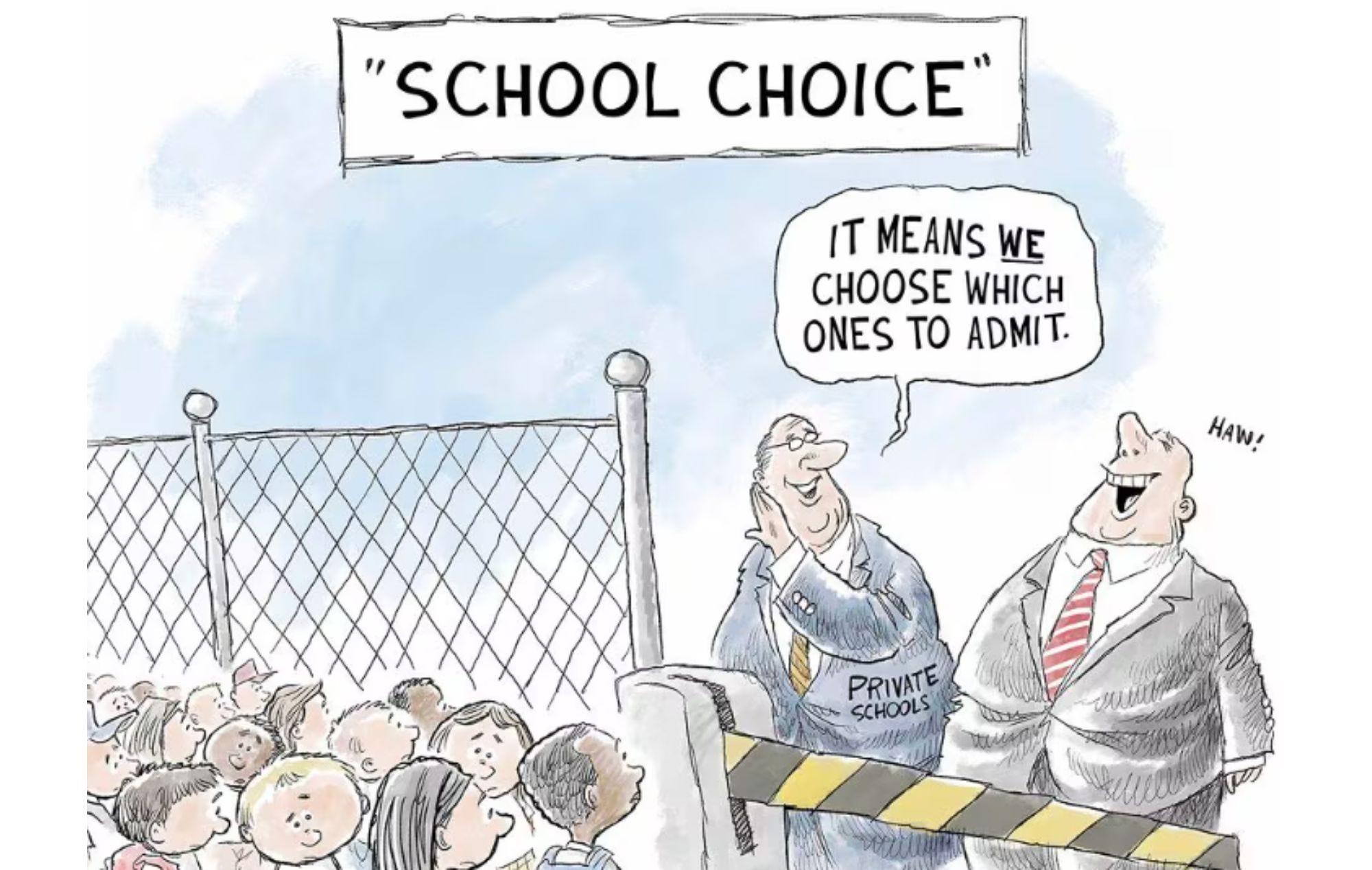
School choice has been around for decades. The idea behind school choice, according to its proponents, is simple: students and families should have alternatives to the public school system. It sounds like a beneficial concept for everyone involved, until you realize that “school choice” is nothing more than clever language meant to mask its true intention of corporatizing education through the destruction of public schools.
Vouchers
School vouchers are one of the biggest threats to public school and they come with their own set of problems. School vouchers give families money towards tuition fees through government funding so that they can homeschool their child or send them to private school. Voucher supporters will (wrongly) proclaim that vouchers have no impact on public school students since public schools use a per student formula. The amount budgeted per student, they say, will stay the same. What they refuse to acknowledge is the fact that per pupil funding also factors in big ticket items such as building maintenance and operations. It’s not all about teacher salaries, textbooks, and school supplies. Vouchers are directly responsible for defunding public schools.
Vouchers also often benefit only the affluent and upper middle class. What good is a $10,000 voucher for a poor or middle-class family looking to enroll their child in a school that costs $30,000 per year? How many families can afford to pay the difference between vouchers and full private school tuition fees? Vouchers greatly favor families who have a lot of money, which goes against the very essence of their existence, since they’re supposed to benefit all students.
School “Choice”
Another argument school choice advocates love to make is that families will get to choose which school they want their child(ren) to attend. How nice and simple. We should have thought of this sooner. If this sounds too good to be true, it is. Let’s make the most obvious argument possible: There’s a wonderful school in your district where every parent wants to send their child. Forgetting for a second the inherent money issues with the voucher system mentioned above, in terms of sheer numbers, it would be absolutely impossible to accept more than a small fraction of students applying for enrollment. In fact, many of these schools use lotteries to determine which students they will accept. So what happens to the vast majority of students who wind up being rejected? They end up going to defunded public schools, as vouchers, charters, and private schools siphon off taxpayer dollars that would normally go back into the public school system.
School choice is an accurate moniker, but it doesn’t mean what most people think. Charter and private schools have way more leeway to expel students than public schools. In fact, Success Academy was sued after “five young Black students with learning and other disabilities... were pushed out of a Success Academy school in Brooklyn.” While charter schools need to set disciplinary policies in accordance with state law, they “do not have to follow Chancellor’s regs or the DOE Discipline Code.” Charters can shape their own disciplinary policies in a way that makes it easier for them to remove students. Charter schools also have other ways of screening out students with special needs and ELLs, such as claiming that they do not offer the services required to support those students. In other words, they have a longer leash when it comes to student screening and expulsion.
Private schools have even fewer restrictions when determining the fate of their students and can basically get away with anything. Many students expelled from charters and private schools wind up in public schools, as school choice supporters brag about how much better they are. Just keep in mind that their definition of “better” is turning away and refusing service to all student populations and families who can’t afford to pay thousands of dollars in tuition payments.
Lack of Advocacy
In New York City, public school educators frequently advocate for their students. Whether it’s internally at the school level, getting parents and students involved, or attending public meetings, educators are often at the forefront when fighting for better conditions for their students, colleagues, and schools. That advocacy rarely exists in charter schools because anyone speaking out against them can be fired at the drop of a hat. That means parents are the only line of defense when it comes to fighting for their children in charter schools. It’s an uphill battle to climb when you have nobody else supporting you.
Defunding the Community
Last week, Chalkbeat published an alarming piece about the school choice tax credit program set to begin in January 2027. According to the article, “At least 23 states… have officially opted into the program.” Two of those states have Democrat governors at the helm, so although this is mostly a Republican push, it has bipartisan support. This program is a direct threat to public schools, our students, our profession, and our communities.
According to the Chalkbeat article, “families can donate up to $1,700 to scholarship-granting organizations and receive an equivalent tax credit back.” Allowing families to receive tax credit to basically fund private schools reduces the amount of tax dollars that go into our community. In fact, in 2022, Kentucky’s Supreme Court “ruled that Kentucky’s tax credit scholarship program is unconstitutional.” As Peter Greene explains, “In a tax credit scholarship program, corporations or individuals contribute money to a ‘scholarship’ fund that will pay part of some student’s tuition at a private school. The state then counts that contribution towards taxes.” In other words, tax dollars are reallocated to private schools instead of going to public schools, projects, and programs that would otherwise benefit our communities.
Don’t be fooled by the clever wording. School choice is a threat to public schools, and to the public, in general. Private and charter schools are inherently exclusionary and usually only serve a very specific subset of students, further fomenting class division, as they leech off the public to fatten their pockets.
Thank you for grounding us in clarity speak! And you do it with such style. Enjoyed your insights and tone. Well done.
As a member of the UFT, I’m actually not opposed to school choice. I think it holds union members in check and creates a little bit of competition, which is good. I think teachers need more incentives to do better in the classroom like merit pay for higher test scores